

Who?
Erwin Van de Velde (alias "Nohara" = Japanese for "field")
Daibutsu 大仏 , the great Buddha in Kamakura, Japan

Kanji "Nohara" by Satoru Toma

a work from 2001, piano jazz player
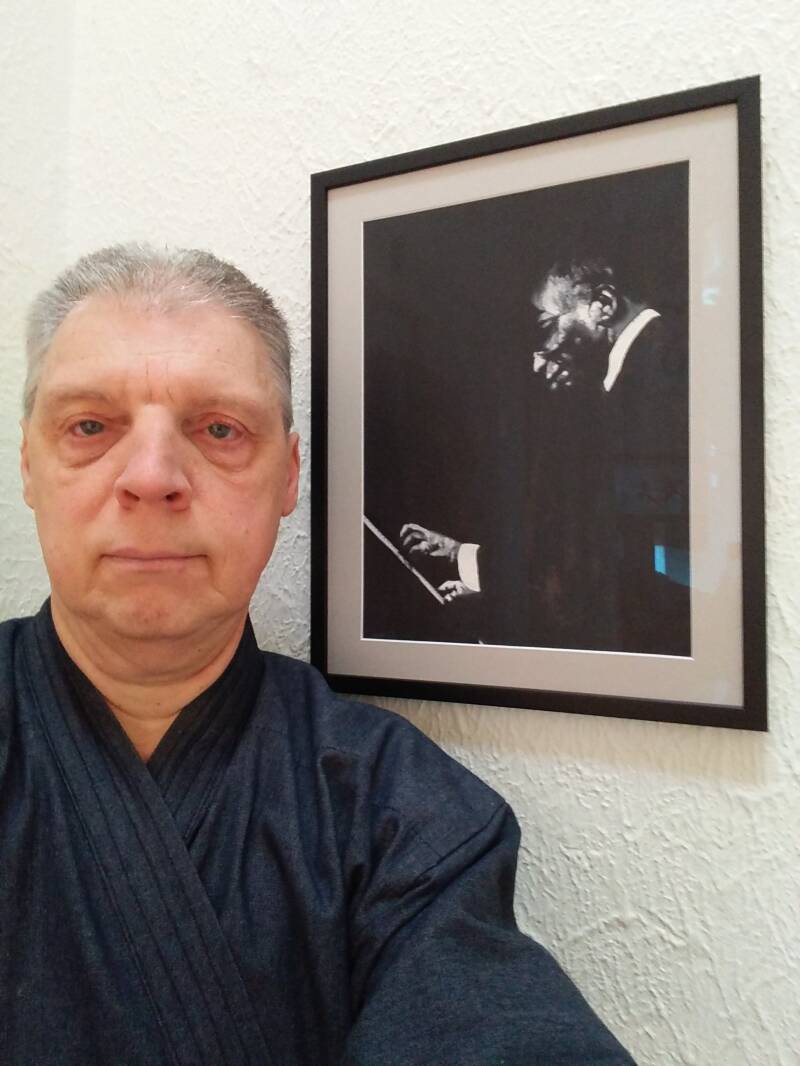
Erwin, you grew up and live in Aalst?
Yes, indeed, and I first came into contact with Japan when I was 6 years old. Like many children, I started with Judo: fighting in cute white suits with colorful belts. However, this did not last long. At the age of 16, I started another Japanese martial art: Karate-Do, where I received my black belt after 5 years. In the meantime, I went to school at the Academie voor Beeldende Kunsten Aalst, where I received my diploma in Interior Design.
During one of the first weeks of the school year, we went on a study trip to the Centre Pompidou in Paris, where I first came into contact with modern art. After an hour and a half, I stepped outside, heavily irritated, and told my teacher Will Van der Perre that this was not art, and that I could do it myself. He smiled and replied that I should then do it. Which I did a few years later. In the meantime, I had taken art history in evening school, where my annoyance with art was replaced by interest.
Did you also practice another Japanese martial art later on?
Yes, that's right: we're making a big leap forward in my life. Around the age of 45, I was reading about the relationship between Japanese philosophy and martial arts, and I discovered that a lesser-known Japanese sport was being practiced by chance within a few hundred meters of my home: Kendo (the way of the sword), where attacks are carried out on each other with bamboo sticks and protective clothing on the head, wrist, and torso. Later I discovered that under the surface of seemingly aggressive and noisy battles, there was a lot of peace and discipline present.
How did you get into Japanese ink arts?
I had always been interested in art, and I had started sporadically with Japanese calligraphy and ink painting with Mrs. Sol Michiels, a Bruges artist who was also interested in Japanese calligraphy and ink painting in her life, in addition to sculpture, drawing, and painting.
Unfortunately, I had to stop Kendo after 10 years due to health problems, and I permanently exchanged my large bamboo stick for a smaller one with a hair, to paint with it.
For practical reasons, I looked for a teacher closer to home, and I found one in Brussels with Mrs. Mikiyo Ikeda, a teacher, graduated from Kyoto University of the Arts, where I further trained in both Shodo (calligraphy) and Sumi-e (ink painting).
In order to accelerate my learning speed, I also started taking Japanese calligraphy lessons simultaneously with Mr. Saturo Toma, an artist, and sumi-e lessons with Mrs. Hiro Ojima, an artist.
Recently, I also attended a private workshop in the Netherlands, with Mrs. Marjon De Jong, a master of Japanese painting.
What attracts you to these two art forms?
My interest in Japan and art has always crossed my life. Visualizing a rich, but complex language using only black ink and paper, or creating an image with just a few lines, is a fascinating concept. On a mental level, just like in martial arts, difficult and complex actions, within strict rules, require a great deal of concentration, causing you to forget time and space, and you are only focused on putting down the right line at the right moment. This feeling of "Flow" described in the book of the same name by Mihaly Csikszentmihalyi, remains a pleasant experience again and again.
As Marjon De Jong describes it, and I quote: "It's about hitting the essence: the essence of the point at which you no longer need to add anything, and at which you can no longer leave anything out."
Erwin, I wish you much success in the future
Arigatoo !
kunstatelier japanse kunst kalligrafie sumi-e kunstwerk schilderen in opdracht Aalst op bestelling Nohara Ink Art Art studio Japanese art calligraphy sumi-e painting on commission Aalst to order Nohara Ink Art